Plotting
\(\newcommand{\footnotename}{footnote}\)
\(\def \LWRfootnote {1}\)
\(\newcommand {\footnote }[2][\LWRfootnote ]{{}^{\mathrm {#1}}}\)
\(\newcommand {\footnotemark }[1][\LWRfootnote ]{{}^{\mathrm {#1}}}\)
\(\let \LWRorighspace \hspace \)
\(\renewcommand {\hspace }{\ifstar \LWRorighspace \LWRorighspace }\)
\(\newcommand {\TextOrMath }[2]{#2}\)
\(\newcommand {\mathnormal }[1]{{#1}}\)
\(\newcommand \ensuremath [1]{#1}\)
\(\newcommand {\LWRframebox }[2][]{\fbox {#2}} \newcommand {\framebox }[1][]{\LWRframebox } \)
\(\newcommand {\setlength }[2]{}\)
\(\newcommand {\addtolength }[2]{}\)
\(\newcommand {\setcounter }[2]{}\)
\(\newcommand {\addtocounter }[2]{}\)
\(\newcommand {\arabic }[1]{}\)
\(\newcommand {\number }[1]{}\)
\(\newcommand {\noalign }[1]{\text {#1}\notag \\}\)
\(\newcommand {\cline }[1]{}\)
\(\newcommand {\directlua }[1]{\text {(directlua)}}\)
\(\newcommand {\luatexdirectlua }[1]{\text {(directlua)}}\)
\(\newcommand {\protect }{}\)
\(\def \LWRabsorbnumber #1 {}\)
\(\def \LWRabsorbquotenumber "#1 {}\)
\(\newcommand {\LWRabsorboption }[1][]{}\)
\(\newcommand {\LWRabsorbtwooptions }[1][]{\LWRabsorboption }\)
\(\def \mathchar {\ifnextchar "\LWRabsorbquotenumber \LWRabsorbnumber }\)
\(\def \mathcode #1={\mathchar }\)
\(\let \delcode \mathcode \)
\(\let \delimiter \mathchar \)
\(\def \oe {\unicode {x0153}}\)
\(\def \OE {\unicode {x0152}}\)
\(\def \ae {\unicode {x00E6}}\)
\(\def \AE {\unicode {x00C6}}\)
\(\def \aa {\unicode {x00E5}}\)
\(\def \AA {\unicode {x00C5}}\)
\(\def \o {\unicode {x00F8}}\)
\(\def \O {\unicode {x00D8}}\)
\(\def \l {\unicode {x0142}}\)
\(\def \L {\unicode {x0141}}\)
\(\def \ss {\unicode {x00DF}}\)
\(\def \SS {\unicode {x1E9E}}\)
\(\def \dag {\unicode {x2020}}\)
\(\def \ddag {\unicode {x2021}}\)
\(\def \P {\unicode {x00B6}}\)
\(\def \copyright {\unicode {x00A9}}\)
\(\def \pounds {\unicode {x00A3}}\)
\(\let \LWRref \ref \)
\(\renewcommand {\ref }{\ifstar \LWRref \LWRref }\)
\( \newcommand {\multicolumn }[3]{#3}\)
\(\require {textcomp}\)
\( \newcommand {\abs }[1]{\lvert #1\rvert } \)
\( \DeclareMathOperator {\sign }{sign} \)
\(\newcommand {\intertext }[1]{\text {#1}\notag \\}\)
\(\let \Hat \hat \)
\(\let \Check \check \)
\(\let \Tilde \tilde \)
\(\let \Acute \acute \)
\(\let \Grave \grave \)
\(\let \Dot \dot \)
\(\let \Ddot \ddot \)
\(\let \Breve \breve \)
\(\let \Bar \bar \)
\(\let \Vec \vec \)
\(\newcommand {\bm }[1]{\boldsymbol {#1}}\)
\(\require {physics}\)
\(\newcommand {\LWRphystrig }[2]{\ifblank {#1}{\textrm {#2}}{\textrm {#2}^{#1}}}\)
\(\renewcommand {\sin }[1][]{\LWRphystrig {#1}{sin}}\)
\(\renewcommand {\sinh }[1][]{\LWRphystrig {#1}{sinh}}\)
\(\renewcommand {\arcsin }[1][]{\LWRphystrig {#1}{arcsin}}\)
\(\renewcommand {\asin }[1][]{\LWRphystrig {#1}{asin}}\)
\(\renewcommand {\cos }[1][]{\LWRphystrig {#1}{cos}}\)
\(\renewcommand {\cosh }[1][]{\LWRphystrig {#1}{cosh}}\)
\(\renewcommand {\arccos }[1][]{\LWRphystrig {#1}{arcos}}\)
\(\renewcommand {\acos }[1][]{\LWRphystrig {#1}{acos}}\)
\(\renewcommand {\tan }[1][]{\LWRphystrig {#1}{tan}}\)
\(\renewcommand {\tanh }[1][]{\LWRphystrig {#1}{tanh}}\)
\(\renewcommand {\arctan }[1][]{\LWRphystrig {#1}{arctan}}\)
\(\renewcommand {\atan }[1][]{\LWRphystrig {#1}{atan}}\)
\(\renewcommand {\csc }[1][]{\LWRphystrig {#1}{csc}}\)
\(\renewcommand {\csch }[1][]{\LWRphystrig {#1}{csch}}\)
\(\renewcommand {\arccsc }[1][]{\LWRphystrig {#1}{arccsc}}\)
\(\renewcommand {\acsc }[1][]{\LWRphystrig {#1}{acsc}}\)
\(\renewcommand {\sec }[1][]{\LWRphystrig {#1}{sec}}\)
\(\renewcommand {\sech }[1][]{\LWRphystrig {#1}{sech}}\)
\(\renewcommand {\arcsec }[1][]{\LWRphystrig {#1}{arcsec}}\)
\(\renewcommand {\asec }[1][]{\LWRphystrig {#1}{asec}}\)
\(\renewcommand {\cot }[1][]{\LWRphystrig {#1}{cot}}\)
\(\renewcommand {\coth }[1][]{\LWRphystrig {#1}{coth}}\)
\(\renewcommand {\arccot }[1][]{\LWRphystrig {#1}{arccot}}\)
\(\renewcommand {\acot }[1][]{\LWRphystrig {#1}{acot}}\)
\(\require {cancel}\)
\(\newcommand {\underuparrow }[1]{{\underset {\uparrow }{#1}}}\)
\(\DeclareMathOperator *{\argmax }{argmax}\)
\(\DeclareMathOperator *{\argmin }{arg\,min}\)
\(\def \E [#1]{\mathbb {E}\!\left [ #1 \right ]}\)
\(\def \Var [#1]{\operatorname {Var}\!\left [ #1 \right ]}\)
\(\def \Cov [#1]{\operatorname {Cov}\!\left [ #1 \right ]}\)
\(\newcommand {\floor }[1]{\lfloor #1 \rfloor }\)
\(\newcommand {\DTFTH }{ H \brk 1{e^{j\omega }}}\)
\(\newcommand {\DTFTX }{ X\brk 1{e^{j\omega }}}\)
\(\newcommand {\DFTtr }[1]{\mathrm {DFT}\left \{#1\right \}}\)
\(\newcommand {\DTFTtr }[1]{\mathrm {DTFT}\left \{#1\right \}}\)
\(\newcommand {\DTFTtrI }[1]{\mathrm {DTFT^{-1}}\left \{#1\right \}}\)
\(\newcommand {\Ftr }[1]{ \mathcal {F}\left \{#1\right \}}\)
\(\newcommand {\FtrI }[1]{ \mathcal {F}^{-1}\left \{#1\right \}}\)
\(\newcommand {\Zover }{\overset {\mathscr Z}{\Longleftrightarrow }}\)
\(\renewcommand {\real }{\mathbb {R}}\)
\(\newcommand {\ba }{\mathbf {a}}\)
\(\newcommand {\bb }{\mathbf {b}}\)
\(\newcommand {\bc }{\mathbf {c}}\)
\(\newcommand {\bd }{\mathbf {d}}\)
\(\newcommand {\be }{\mathbf {e}}\)
\(\newcommand {\bf }{\mathbf {f}}\)
\(\newcommand {\bg }{\mathbf {g}}\)
\(\newcommand {\bh }{\mathbf {h}}\)
\(\newcommand {\bi }{\mathbf {i}}\)
\(\newcommand {\bn }{\mathbf {n}}\)
\(\newcommand {\bo }{\mathbf {o}}\)
\(\newcommand {\bp }{\mathbf {p}}\)
\(\newcommand {\bq }{\mathbf {q}}\)
\(\newcommand {\br }{\mathbf {r}}\)
\(\newcommand {\bs }{\mathbf {s}}\)
\(\newcommand {\bt }{\mathbf {t}}\)
\(\newcommand {\bu }{\mathbf {u}}\)
\(\newcommand {\bv }{\mathbf {v}}\)
\(\newcommand {\bw }{\mathbf {w}}\)
\(\newcommand {\bx }{\mathbf {x}}\)
\(\newcommand {\bxx }{\mathbf {xx}}\)
\(\newcommand {\bxy }{\mathbf {xy}}\)
\(\newcommand {\by }{\mathbf {y}}\)
\(\newcommand {\byx }{\mathbf {yx}}\)
\(\newcommand {\byy }{\mathbf {yy}}\)
\(\newcommand {\bz }{\mathbf {z}}\)
\(\newcommand {\bA }{\mathbf {A}}\)
\(\newcommand {\bB }{\mathbf {B}}\)
\(\newcommand {\bC }{\mathbf {C}}\)
\(\newcommand {\bD }{\mathbf {D}}\)
\(\newcommand {\bH }{\mathbf {H}}\)
\(\newcommand {\bI }{\mathbf {I}}\)
\(\newcommand {\bK }{\mathbf {K}}\)
\(\newcommand {\bM }{\mathbf {M}}\)
\(\newcommand {\bP }{\mathbf {P}}\)
\(\newcommand {\bQ }{\mathbf {Q}}\)
\(\newcommand {\bR }{\mathbf {R}}\)
\(\newcommand {\bS }{\mathbf {S}}\)
\(\newcommand {\bU }{\mathbf {U}}\)
\(\newcommand {\bW }{\mathbf {W}}\)
\(\newcommand {\bX }{\mathbf {X}}\)
\(\newcommand {\bY }{\mathbf {Y}}\)
\(\newcommand {\bZ }{\mathbf {Z}}\)
\(\newcommand {\balpha }{\bm {\alpha }}\)
\(\newcommand {\bth }{{\bm {\theta }}}\)
\(\newcommand {\bepsilon }{{\bm {\epsilon }}}\)
\(\newcommand {\bmu }{{\bm {\mu }}}\)
\(\newcommand {\bgamma }{{\bm {\gamma }}}\)
\(\newcommand {\bphi }{\bm {\phi }}\)
\(\newcommand {\bOne }{\mathbf {1}}\)
\(\newcommand {\bZero }{\mathbf {0}}\)
\(\newcommand {\indFunc }{\mathbb {1}}\)
\(\newcommand {\btx }{\tilde {\bx }}\)
\(\newcommand {\loss }{\mathcal {L}}\)
\(\newcommand {\score }{\mathcal {S}}\)
\(\newcommand {\SSE }{\mathrm {SSE}}\)
\(\newcommand {\SST }{\mathrm {SST}}\)
\(\newcommand {\SSR }{\mathrm {SSR}}\)
\(\newcommand {\MSE }{\mathrm {MSE}}\)
\(\newcommand {\RMSE }{\mathrm {RMSE}}\)
\(\newcommand {\toprule }[1][]{\hline }\)
\(\let \midrule \toprule \)
\(\let \bottomrule \toprule \)
\(\def \LWRbooktabscmidruleparen (#1)#2{}\)
\(\newcommand {\LWRbooktabscmidrulenoparen }[1]{}\)
\(\newcommand {\cmidrule }[1][]{\ifnextchar (\LWRbooktabscmidruleparen \LWRbooktabscmidrulenoparen }\)
\(\newcommand {\morecmidrules }{}\)
\(\newcommand {\specialrule }[3]{\hline }\)
\(\newcommand {\addlinespace }[1][]{}\)
\(\newcommand {\LWRsubmultirow }[2][]{#2}\)
\(\newcommand {\LWRmultirow }[2][]{\LWRsubmultirow }\)
\(\newcommand {\multirow }[2][]{\LWRmultirow }\)
\(\newcommand {\mrowcell }{}\)
\(\newcommand {\mcolrowcell }{}\)
\(\newcommand {\STneed }[1]{}\)
\(\newcommand {\tcbset }[1]{}\)
\(\newcommand {\tcbsetforeverylayer }[1]{}\)
\(\newcommand {\tcbox }[2][]{\boxed {\text {#2}}}\)
\(\newcommand {\tcboxfit }[2][]{\boxed {#2}}\)
\(\newcommand {\tcblower }{}\)
\(\newcommand {\tcbline }{}\)
\(\newcommand {\tcbtitle }{}\)
\(\newcommand {\tcbsubtitle [2][]{\mathrm {#2}}}\)
\(\newcommand {\tcboxmath }[2][]{\boxed {#2}}\)
\(\newcommand {\tcbhighmath }[2][]{\boxed {#2}}\)
\(\require {colortbl}\)
\(\let \LWRorigcolumncolor \columncolor \)
\(\renewcommand {\columncolor }[2][named]{\LWRorigcolumncolor [#1]{#2}\LWRabsorbtwooptions }\)
\(\let \LWRorigrowcolor \rowcolor \)
\(\renewcommand {\rowcolor }[2][named]{\LWRorigrowcolor [#1]{#2}\LWRabsorbtwooptions }\)
\(\let \LWRorigcellcolor \cellcolor \)
\(\renewcommand {\cellcolor }[2][named]{\LWRorigcellcolor [#1]{#2}\LWRabsorbtwooptions }\)
\(\newcommand {\tothe }[1]{^{#1}}\)
\(\newcommand {\raiseto }[2]{{#2}^{#1}}\)
\(\newcommand {\LWRsiunitxEND }{}\)
\(\def \LWRsiunitxang #1;#2;#3;#4\LWRsiunitxEND {\ifblank {#1}{}{\num {#1}\degree }\ifblank {#2}{}{\num {#2}^{\unicode {x2032}}}\ifblank {#3}{}{\num {#3}^{\unicode {x2033}}}}\)
\(\newcommand {\ang }[2][]{\LWRsiunitxang #2;;;\LWRsiunitxEND }\)
\(\def \LWRsiunitxdistribunit {}\)
\(\newcommand {\LWRsiunitxENDTWO }{}\)
\(\def \LWRsiunitxprintdecimalsubtwo #1,#2,#3\LWRsiunitxENDTWO {\ifblank {#1}{0}{\mathrm {#1}}\ifblank {#2}{}{{\LWRsiunitxdecimal }\mathrm {#2}}}\)
\(\def \LWRsiunitxprintdecimalsub #1.#2.#3\LWRsiunitxEND {\LWRsiunitxprintdecimalsubtwo #1,,\LWRsiunitxENDTWO \ifblank {#2}{}{{\LWRsiunitxdecimal }\LWRsiunitxprintdecimalsubtwo
#2,,\LWRsiunitxENDTWO }}\)
\(\newcommand {\LWRsiunitxprintdecimal }[1]{\LWRsiunitxprintdecimalsub #1...\LWRsiunitxEND }\)
\(\def \LWRsiunitxnumplus #1+#2+#3\LWRsiunitxEND {\ifblank {#2}{\LWRsiunitxprintdecimal {#1}}{\ifblank {#1}{\LWRsiunitxprintdecimal {#2}}{\LWRsiunitxprintdecimal {#1}\unicode
{x02B}\LWRsiunitxprintdecimal {#2}}}\LWRsiunitxdistribunit }\)
\(\def \LWRsiunitxnumminus #1-#2-#3\LWRsiunitxEND {\ifblank {#2}{\LWRsiunitxnumplus #1+++\LWRsiunitxEND }{\ifblank {#1}{}{\LWRsiunitxprintdecimal {#1}}\unicode {x02212}\LWRsiunitxprintdecimal
{#2}\LWRsiunitxdistribunit }}\)
\(\def \LWRsiunitxnumpmmacro #1\pm #2\pm #3\LWRsiunitxEND {\ifblank {#2}{\LWRsiunitxnumminus #1---\LWRsiunitxEND }{\LWRsiunitxprintdecimal {#1}\unicode {x0B1}\LWRsiunitxprintdecimal
{#2}\LWRsiunitxdistribunit }}\)
\(\def \LWRsiunitxnumpm #1+-#2+-#3\LWRsiunitxEND {\ifblank {#2}{\LWRsiunitxnumpmmacro #1\pm \pm \pm \LWRsiunitxEND }{\LWRsiunitxprintdecimal {#1}\unicode {x0B1}\LWRsiunitxprintdecimal
{#2}\LWRsiunitxdistribunit }}\)
\(\newcommand {\LWRsiunitxnumscientific }[2]{\ifblank {#1}{}{\ifstrequal {#1}{-}{-}{\LWRsiunitxprintdecimal {#1}\times }}10^{\LWRsiunitxprintdecimal {#2}}\LWRsiunitxdistribunit }\)
\(\def \LWRsiunitxnumD #1D#2D#3\LWRsiunitxEND {\ifblank {#2}{\LWRsiunitxnumpm #1+-+-\LWRsiunitxEND }{\mathrm {\LWRsiunitxnumscientific {#1}{#2}}}}\)
\(\def \LWRsiunitxnumd #1d#2d#3\LWRsiunitxEND {\ifblank {#2}{\LWRsiunitxnumD #1DDD\LWRsiunitxEND }{\mathrm {\LWRsiunitxnumscientific {#1}{#2}}}}\)
\(\def \LWRsiunitxnumE #1E#2E#3\LWRsiunitxEND {\ifblank {#2}{\LWRsiunitxnumd #1ddd\LWRsiunitxEND }{\mathrm {\LWRsiunitxnumscientific {#1}{#2}}}}\)
\(\def \LWRsiunitxnume #1e#2e#3\LWRsiunitxEND {\ifblank {#2}{\LWRsiunitxnumE #1EEE\LWRsiunitxEND }{\mathrm {\LWRsiunitxnumscientific {#1}{#2}}}}\)
\(\def \LWRsiunitxnumx #1x#2x#3x#4\LWRsiunitxEND {\ifblank {#2}{\LWRsiunitxnume #1eee\LWRsiunitxEND }{\ifblank {#3}{\LWRsiunitxnume #1eee\LWRsiunitxEND \times \LWRsiunitxnume
#2eee\LWRsiunitxEND }{\LWRsiunitxnume #1eee\LWRsiunitxEND \times \LWRsiunitxnume #2eee\LWRsiunitxEND \times \LWRsiunitxnume #3eee\LWRsiunitxEND }}}\)
\(\newcommand {\num }[2][]{\LWRsiunitxnumx #2xxxxx\LWRsiunitxEND }\)
\(\newcommand {\si }[2][]{\mathrm {\gsubstitute {#2}{~}{\,}}}\)
\(\def \LWRsiunitxSIopt #1[#2]#3{\def \LWRsiunitxdistribunit {\,\si {#3}}{#2}\num {#1}\def \LWRsiunitxdistribunit {}}\)
\(\newcommand {\LWRsiunitxSI }[2]{\def \LWRsiunitxdistribunit {\,\si {#2}}\num {#1}\def \LWRsiunitxdistribunit {}}\)
\(\newcommand {\SI }[2][]{\ifnextchar [{\LWRsiunitxSIopt {#2}}{\LWRsiunitxSI {#2}}}\)
\(\newcommand {\numlist }[2][]{\text {#2}}\)
\(\newcommand {\numrange }[3][]{\num {#2}\ \LWRsiunitxrangephrase \ \num {#3}}\)
\(\newcommand {\SIlist }[3][]{\text {#2}\,\si {#3}}\)
\(\newcommand {\SIrange }[4][]{\num {#2}\,#4\ \LWRsiunitxrangephrase \ \num {#3}\,#4}\)
\(\newcommand {\tablenum }[2][]{\mathrm {#2}}\)
\(\newcommand {\ampere }{\mathrm {A}}\)
\(\newcommand {\candela }{\mathrm {cd}}\)
\(\newcommand {\kelvin }{\mathrm {K}}\)
\(\newcommand {\kilogram }{\mathrm {kg}}\)
\(\newcommand {\metre }{\mathrm {m}}\)
\(\newcommand {\mole }{\mathrm {mol}}\)
\(\newcommand {\second }{\mathrm {s}}\)
\(\newcommand {\becquerel }{\mathrm {Bq}}\)
\(\newcommand {\degreeCelsius }{\unicode {x2103}}\)
\(\newcommand {\coulomb }{\mathrm {C}}\)
\(\newcommand {\farad }{\mathrm {F}}\)
\(\newcommand {\gray }{\mathrm {Gy}}\)
\(\newcommand {\hertz }{\mathrm {Hz}}\)
\(\newcommand {\henry }{\mathrm {H}}\)
\(\newcommand {\joule }{\mathrm {J}}\)
\(\newcommand {\katal }{\mathrm {kat}}\)
\(\newcommand {\lumen }{\mathrm {lm}}\)
\(\newcommand {\lux }{\mathrm {lx}}\)
\(\newcommand {\newton }{\mathrm {N}}\)
\(\newcommand {\ohm }{\mathrm {\Omega }}\)
\(\newcommand {\pascal }{\mathrm {Pa}}\)
\(\newcommand {\radian }{\mathrm {rad}}\)
\(\newcommand {\siemens }{\mathrm {S}}\)
\(\newcommand {\sievert }{\mathrm {Sv}}\)
\(\newcommand {\steradian }{\mathrm {sr}}\)
\(\newcommand {\tesla }{\mathrm {T}}\)
\(\newcommand {\volt }{\mathrm {V}}\)
\(\newcommand {\watt }{\mathrm {W}}\)
\(\newcommand {\weber }{\mathrm {Wb}}\)
\(\newcommand {\day }{\mathrm {d}}\)
\(\newcommand {\degree }{\mathrm {^\circ }}\)
\(\newcommand {\hectare }{\mathrm {ha}}\)
\(\newcommand {\hour }{\mathrm {h}}\)
\(\newcommand {\litre }{\mathrm {l}}\)
\(\newcommand {\liter }{\mathrm {L}}\)
\(\newcommand {\arcminute }{^\prime }\)
\(\newcommand {\minute }{\mathrm {min}}\)
\(\newcommand {\arcsecond }{^{\prime \prime }}\)
\(\newcommand {\tonne }{\mathrm {t}}\)
\(\newcommand {\astronomicalunit }{au}\)
\(\newcommand {\atomicmassunit }{u}\)
\(\newcommand {\bohr }{\mathit {a}_0}\)
\(\newcommand {\clight }{\mathit {c}_0}\)
\(\newcommand {\dalton }{\mathrm {D}_\mathrm {a}}\)
\(\newcommand {\electronmass }{\mathit {m}_{\mathrm {e}}}\)
\(\newcommand {\electronvolt }{\mathrm {eV}}\)
\(\newcommand {\elementarycharge }{\mathit {e}}\)
\(\newcommand {\hartree }{\mathit {E}_{\mathrm {h}}}\)
\(\newcommand {\planckbar }{\mathit {\unicode {x210F}}}\)
\(\newcommand {\angstrom }{\mathrm {\unicode {x212B}}}\)
\(\let \LWRorigbar \bar \)
\(\newcommand {\bar }{\mathrm {bar}}\)
\(\newcommand {\barn }{\mathrm {b}}\)
\(\newcommand {\bel }{\mathrm {B}}\)
\(\newcommand {\decibel }{\mathrm {dB}}\)
\(\newcommand {\knot }{\mathrm {kn}}\)
\(\newcommand {\mmHg }{\mathrm {mmHg}}\)
\(\newcommand {\nauticalmile }{\mathrm {M}}\)
\(\newcommand {\neper }{\mathrm {Np}}\)
\(\newcommand {\yocto }{\mathrm {y}}\)
\(\newcommand {\zepto }{\mathrm {z}}\)
\(\newcommand {\atto }{\mathrm {a}}\)
\(\newcommand {\femto }{\mathrm {f}}\)
\(\newcommand {\pico }{\mathrm {p}}\)
\(\newcommand {\nano }{\mathrm {n}}\)
\(\newcommand {\micro }{\mathrm {\unicode {x00B5}}}\)
\(\newcommand {\milli }{\mathrm {m}}\)
\(\newcommand {\centi }{\mathrm {c}}\)
\(\newcommand {\deci }{\mathrm {d}}\)
\(\newcommand {\deca }{\mathrm {da}}\)
\(\newcommand {\hecto }{\mathrm {h}}\)
\(\newcommand {\kilo }{\mathrm {k}}\)
\(\newcommand {\mega }{\mathrm {M}}\)
\(\newcommand {\giga }{\mathrm {G}}\)
\(\newcommand {\tera }{\mathrm {T}}\)
\(\newcommand {\peta }{\mathrm {P}}\)
\(\newcommand {\exa }{\mathrm {E}}\)
\(\newcommand {\zetta }{\mathrm {Z}}\)
\(\newcommand {\yotta }{\mathrm {Y}}\)
\(\newcommand {\percent }{\mathrm {\%}}\)
\(\newcommand {\meter }{\mathrm {m}}\)
\(\newcommand {\metre }{\mathrm {m}}\)
\(\newcommand {\gram }{\mathrm {g}}\)
\(\newcommand {\kg }{\kilo \gram }\)
\(\newcommand {\of }[1]{_{\mathrm {#1}}}\)
\(\newcommand {\squared }{^2}\)
\(\newcommand {\square }[1]{\mathrm {#1}^2}\)
\(\newcommand {\cubed }{^3}\)
\(\newcommand {\cubic }[1]{\mathrm {#1}^3}\)
\(\newcommand {\per }{\,\mathrm {/}}\)
\(\newcommand {\celsius }{\unicode {x2103}}\)
\(\newcommand {\fg }{\femto \gram }\)
\(\newcommand {\pg }{\pico \gram }\)
\(\newcommand {\ng }{\nano \gram }\)
\(\newcommand {\ug }{\micro \gram }\)
\(\newcommand {\mg }{\milli \gram }\)
\(\newcommand {\g }{\gram }\)
\(\newcommand {\kg }{\kilo \gram }\)
\(\newcommand {\amu }{\mathrm {u}}\)
\(\newcommand {\pm }{\pico \metre }\)
\(\newcommand {\nm }{\nano \metre }\)
\(\newcommand {\um }{\micro \metre }\)
\(\newcommand {\mm }{\milli \metre }\)
\(\newcommand {\cm }{\centi \metre }\)
\(\newcommand {\dm }{\deci \metre }\)
\(\newcommand {\m }{\metre }\)
\(\newcommand {\km }{\kilo \metre }\)
\(\newcommand {\as }{\atto \second }\)
\(\newcommand {\fs }{\femto \second }\)
\(\newcommand {\ps }{\pico \second }\)
\(\newcommand {\ns }{\nano \second }\)
\(\newcommand {\us }{\micro \second }\)
\(\newcommand {\ms }{\milli \second }\)
\(\newcommand {\s }{\second }\)
\(\newcommand {\fmol }{\femto \mol }\)
\(\newcommand {\pmol }{\pico \mol }\)
\(\newcommand {\nmol }{\nano \mol }\)
\(\newcommand {\umol }{\micro \mol }\)
\(\newcommand {\mmol }{\milli \mol }\)
\(\newcommand {\mol }{\mol }\)
\(\newcommand {\kmol }{\kilo \mol }\)
\(\newcommand {\pA }{\pico \ampere }\)
\(\newcommand {\nA }{\nano \ampere }\)
\(\newcommand {\uA }{\micro \ampere }\)
\(\newcommand {\mA }{\milli \ampere }\)
\(\newcommand {\A }{\ampere }\)
\(\newcommand {\kA }{\kilo \ampere }\)
\(\newcommand {\ul }{\micro \litre }\)
\(\newcommand {\ml }{\milli \litre }\)
\(\newcommand {\l }{\litre }\)
\(\newcommand {\hl }{\hecto \litre }\)
\(\newcommand {\uL }{\micro \liter }\)
\(\newcommand {\mL }{\milli \liter }\)
\(\newcommand {\L }{\liter }\)
\(\newcommand {\hL }{\hecto \liter }\)
\(\newcommand {\mHz }{\milli \hertz }\)
\(\newcommand {\Hz }{\hertz }\)
\(\newcommand {\kHz }{\kilo \hertz }\)
\(\newcommand {\MHz }{\mega \hertz }\)
\(\newcommand {\GHz }{\giga \hertz }\)
\(\newcommand {\THz }{\tera \hertz }\)
\(\newcommand {\mN }{\milli \newton }\)
\(\newcommand {\N }{\newton }\)
\(\newcommand {\kN }{\kilo \newton }\)
\(\newcommand {\MN }{\mega \newton }\)
\(\newcommand {\Pa }{\pascal }\)
\(\newcommand {\kPa }{\kilo \pascal }\)
\(\newcommand {\MPa }{\mega \pascal }\)
\(\newcommand {\GPa }{\giga \pascal }\)
\(\newcommand {\mohm }{\milli \ohm }\)
\(\newcommand {\kohm }{\kilo \ohm }\)
\(\newcommand {\Mohm }{\mega \ohm }\)
\(\newcommand {\pV }{\pico \volt }\)
\(\newcommand {\nV }{\nano \volt }\)
\(\newcommand {\uV }{\micro \volt }\)
\(\newcommand {\mV }{\milli \volt }\)
\(\newcommand {\V }{\volt }\)
\(\newcommand {\kV }{\kilo \volt }\)
\(\newcommand {\W }{\watt }\)
\(\newcommand {\uW }{\micro \watt }\)
\(\newcommand {\mW }{\milli \watt }\)
\(\newcommand {\kW }{\kilo \watt }\)
\(\newcommand {\MW }{\mega \watt }\)
\(\newcommand {\GW }{\giga \watt }\)
\(\newcommand {\J }{\joule }\)
\(\newcommand {\uJ }{\micro \joule }\)
\(\newcommand {\mJ }{\milli \joule }\)
\(\newcommand {\kJ }{\kilo \joule }\)
\(\newcommand {\eV }{\electronvolt }\)
\(\newcommand {\meV }{\milli \electronvolt }\)
\(\newcommand {\keV }{\kilo \electronvolt }\)
\(\newcommand {\MeV }{\mega \electronvolt }\)
\(\newcommand {\GeV }{\giga \electronvolt }\)
\(\newcommand {\TeV }{\tera \electronvolt }\)
\(\newcommand {\kWh }{\kilo \watt \hour }\)
\(\newcommand {\F }{\farad }\)
\(\newcommand {\fF }{\femto \farad }\)
\(\newcommand {\pF }{\pico \farad }\)
\(\newcommand {\K }{\mathrm {K}}\)
\(\newcommand {\dB }{\mathrm {dB}}\)
\(\newcommand {\kibi }{\mathrm {Ki}}\)
\(\newcommand {\mebi }{\mathrm {Mi}}\)
\(\newcommand {\gibi }{\mathrm {Gi}}\)
\(\newcommand {\tebi }{\mathrm {Ti}}\)
\(\newcommand {\pebi }{\mathrm {Pi}}\)
\(\newcommand {\exbi }{\mathrm {Ei}}\)
\(\newcommand {\zebi }{\mathrm {Zi}}\)
\(\newcommand {\yobi }{\mathrm {Yi}}\)
\(\let \unit \si \)
\(\let \qty \SI \)
\(\let \qtylist \SIlist \)
\(\let \qtyrange \SIrange \)
\(\let \numproduct \num \)
\(\let \qtyproduct \SI \)
\(\let \complexnum \num \)
\(\newcommand {\complexqty }[3][]{(\complexnum {#2})\si {#3}}\)
\(\renewcommand {\pm }{\mathbin {\unicode {x00B1}}}\)
\(\def \LWRsiunitxrangephrase {\TextOrMath { }{\ }\protect \mbox {to}\TextOrMath { }{\ }}\)
\(\def \LWRsiunitxdecimal {.}\)
4 What the Eye Does for Free
Sight carries more information per second than the other senses combined, but it does not deliver that bandwidth uniformly. Table 4.1 puts numbers on the first claim: the
eyes alone move about \(10^{7}\) bit/s, and the five channels together deliver roughly \(11\) million bit/s to the brain. Conscious processing keeps up with only about \(50\) bit/s, so almost everything is
discarded before it reaches awareness. A chart is a device for choosing what survives that reduction, and it is effective in proportion to how much of the reader’s throughput it spends on the data rather than on decoding the chart.
Table 4.1: Information transmission rates of the five senses. The eyes carry two orders of magnitude more than the ears, and the five channels together deliver about \(11\) million bit/s, while conscious processing
handles only about \(50\) bit/s. That gap of more than five orders of magnitude is the compression every figure in this document is trying to help the reader perform. After the Encyclopædia Britannica entry on
information theory.
.
Sensory system
Rate (bit/s)
Eyes
\(10^{7}\)
Skin
\(10^{6}\)
Ears
\(10^{5}\)
Smell
\(10^{5}\)
Taste
\(10^{3}\)
Visual processing runs in two stages:
1. The first stage is pre-attentive : a small set of features is extracted from the entire visual field in parallel, in roughly the \(200\) ms between one eye movement and the next,
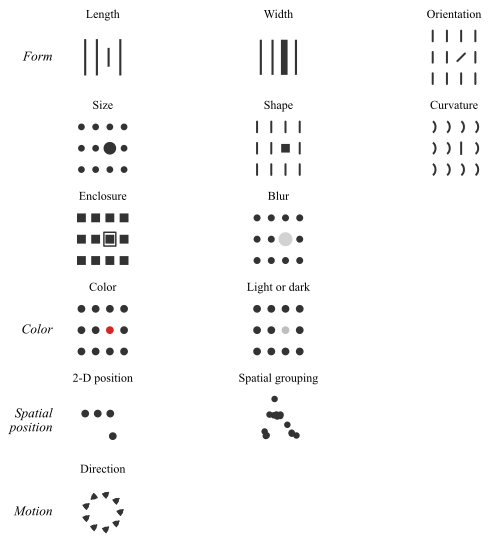
without conscious effort and without regard to how many objects are present. The list is short and has been established experimentally: length, width, size, curvature, number, line ends, intersection, closure, color, how light or dark
a mark is, flicker, direction of motion, and a few depth cues.serial . It identifies objects and their arrangement, it consults memory, and its cost grows with the number of items to be examined.
Fig. 4.1 shows each of these channels in isolation: in every small grid one mark differs from the rest along a single feature, and the eye lands on it without a
search.
Figure 4.1: The pre-attentive attributes, one small grid each, grouped as Form , Color , Spatial position and Motion . Every grid hides a single odd element, and it is found without
a search. Flicker and direction of motion are pre-attentive on the same footing but cannot be shown on a static page, so Direction only hints a heading through the arrows. After Few, Show Me the Numbers
(2012), via the DLI human-perception slides.
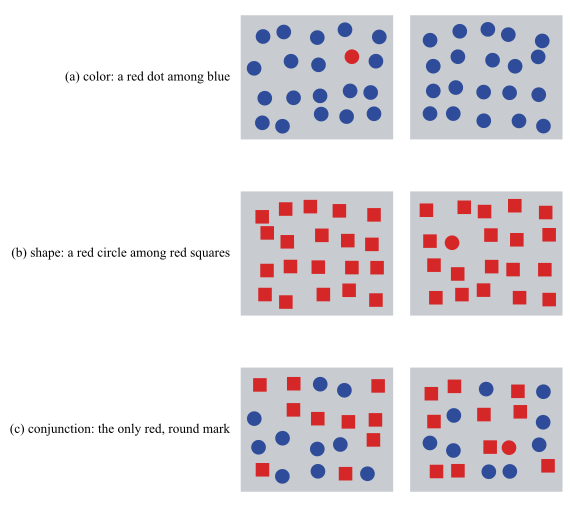
The three demonstrations of Fig. 4.2 show what the difference between the two stages feels like.
Figure 4.2: Three single-feature searches, each posed the way the source poses it: which side holds the odd mark? (a) A red dot among blue and (b) a red circle among red squares are answered before the eye has moved,
however many marks are present, because color and shape are each pre-attentive. (c) The target is the only mark that is both red and round, among blue circles and red squares; that conjunction is not pre-attentive, so
the side can be found only by checking marks one at a time.
The practical consequence is the third row. A reader can be asked to find the red mark, or the round mark, and will find it instantly however many distractors there are. A reader asked to find the mark that is red and
round has to inspect the marks one at a time, and the time taken grows with their number.
Encoding one variable in color and a second in marker shape, and then asking the reader to locate a particular combination. Two channels are fine for two independent readings, and they fail for a conjunction.
4.1 Two ways a graph is read
A reader arrives at a figure with one of two questions, and the two are served by different halves of the machinery above.
• Pattern perception asks what the shape is: which values are large, where the group boundaries fall, whether the decay is smooth. It rides the parallel stage, so it is free and it scales,
and twenty marks are taken in as fast as five.
• Table look-up asks for one named item and its value.1 It is a search, so it runs in the serial stage, and its cost grows with the number of marks unless the order of the
rows tells the reader where to stop.
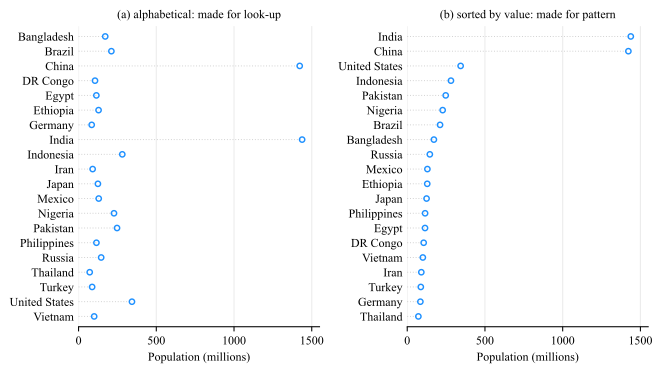
Fig. 4.3 draws one set of twenty numbers twice, changing nothing but that order.
Figure 4.3: The populations of the 20 most populated countries, drawn twice with nothing changed but the order of the rows. (a) Alphabetical: Country is found in one jump, and the distribution of populations has to be
assembled row by row. (b) Sorted by value; country now costs a scan of up to twenty rows. Example after Cleveland, The Elements of Graphing Data . Data: United Nations, World Population Prospects , 2024
revision, mid-\(2023\) estimates.
Neither panel answers both questions, and the one it answers is decided by the ordering rather than by the encoding, which is identical in the two. So the ordering is not a formatting detail. Most figures in a technical document are
read for pattern, which is why sorting by value is the default (Sec. 11 ).
Figure\(\rightarrow \)Table
a figure that is genuinely consulted by name wants alphabetical order; and a figure that is only ever consulted by name wants to be a table (App. A ).