Machine Learning & Signals Learning
26 Signal Classifiers
26.1 Preface
Given a training set of labeled signals, the task is to assign a whole signal \(y[n],\,n=0,\ldots ,L-1\) to one of \(C\) discrete classes. Unlike the regression setting of earlier chapters, the input is a sequence of inter-related samples rather than a fixed-length feature vector.
Dataset Signals in a dataset may be
-
• univariate (single channel \(y[n]\)) or multivariate (\(K\) channels \(y_k[n]\), e.g. ECG leads or accelerometer axes);
-
• equal-length or variable-length (length \(L\) may differ between examples);
-
• scarce: labeled time-series datasets are typically small relative to \(L\).
Overfitting challenge Using each sample \(y[n]\) as a feature yields an \(L\)-dimensional input from only a handful of training examples, so a raw-sample classifier overfits easily. The methods below differ mainly in how they summarize, transform, or compare signals before classification in order to control this.
-
• Distance-based: define an elastic distance between raw signals and apply \(k\)-NN (Dynamic Time Warping).
-
• Feature-based: extract interpretable summaries and classify on them (time-series forest / RISE, shapelets, SAX and SAX-VSM). The general feature-extraction pipeline these methods specialize is covered in Sec. 25.4.
-
• Specially adapted transforms: apply a large bank of random or fixed transforms followed by a linear classifier (ROCKET, MINIROCKET), or combine several domain-specific classifiers in a meta-ensemble (HIVE-COTE).
-
• Deep learning (out of scope here, pointer only): 1D CNNs, RNNs, and pretrained time-series foundation models. These are contrasted with classical methods in the closing table.
26.2 Distance Metrics
The standard distances are merely applicable
The standard distance metrics of Sec. 10.2 treat a signal as a plain vector in \(\real ^L\) and pair samples index-by-index. For signals this is rarely what we want, for two reasons:
-
• Sample-to-sample comparison: Distances, such as \(L_p\) and cosine, are sensitive to any misalignment along the time axis, such as a shift, a stretch, a local speed change, or an additional/missing event, even when the two signals share the same underlying characteristics. They are also restricted to equal-length inputs.
-
• Curse of dimensionality: treating each of the \(L\) samples as a separate feature places the classifier in the ultra-high-dimensional regime (Sec. 10.4).
The distance below are particularly fit to signals of the certain kinds.
26.2.1 Dynamic Time Warping (DTW)
-
Goal: “Elastic” distance metric between two signals.
-
• Time-domain, non-linear metric that can stretch and compress the time axis to find the best possible match between sequences.
-
• Applied for k-NN and other classifiers.
-
• Historically, developed to compare same/different words spoken with different speed.
-
Definition
Given two signals of lengths \(M\) and \(L\) [9],
\(\seteqnumber{0}{}{0}\)\begin{equation} \begin{aligned} X &= \left (x_1,\ldots ,x_m,\ldots ,x_M\right ),\\ Y &= \left (y_1,\ldots ,y_n,\ldots ,y_L\right ),\\ \end {aligned} \end{equation}
the DTW algorithm takes as input a pointwise dissimilarity function
\(\seteqnumber{0}{}{1}\)\begin{equation} d_{mn} = f(x_m,y_n)\ge 0. \end{equation}
A common choice is the 1D Euclidean distance, \(d_{mn} = \abs {x_m-y_n}\).
A warping path is a sequence of index pairs \(\pi = \{(m_k,n_k)\}_{k=1}^{K}\) that satisfies three constraints:
-
• Boundary: \((m_1,n_1)=(1,1)\) and \((m_K,n_K)=(M,L)\), i.e. the two signals are forced to match at both ends.
-
• Monotonicity: \(m_{k+1}\ge m_k\) and \(n_{k+1}\ge n_k\) (no turns back).
-
• Step size: each step is vertical \((m{+}1,n)\), horizontal \((m,n{+}1)\), or diagonal \((m{+}1,n{+}1)\) (no skips).
The DTW distance is the minimum cumulative cost along any admissible path,
\(\seteqnumber{0}{}{2}\)\begin{equation} \mathrm {DTW}(X,Y) = \min _{\pi }\sum _{k=1}^{K} d_{m_k n_k}, \end{equation}
and is obtained by dynamic programming over the cost matrix \([d_{mn}]\), \(m=1,\ldots ,M\), \(n=1,\ldots ,L\), in \(O(ML)\) time. The resulting path serves as an elastic distance between the two signals, allowing non-linear stretching of the time axis.
Unlike Euclidean distance, which pairs samples index-by-index and therefore penalizes any time shift or stretch, DTW is free to re-align the time axes and then measures the residual mismatch under the best alignment. The distance is therefore small whenever \(X\) and \(Y\) share the same shape, even if one is faster, slower, or shifted in time.
-
• DTW is a dissimilarity measure, not a true metric; of the axioms of Sec. 10.2.1, the triangle inequality does not hold in general,
\(\seteqnumber{0}{}{3}\)\begin{equation} \label {eq-dtw-triangle} \mathrm {DTW}(X,Z)\;\le \;\mathrm {DTW}(X,Y)+\mathrm {DTW}(Y,Z)\qquad \text {(not guaranteed)}. \end{equation}
-
• The raw sum depends on path length. To compare pairs with different \(M,L\), it is common to normalize by the number of steps \(K\), or by \(M+L\) (mean cost per step).
-
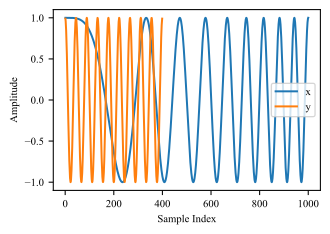
Example 26.1: Three signals are used throughout this section (Fig. 26.1): \(X\) is a chirp of \(M=1000\) samples, whose instantaneous frequency grows along the record; \(Y\) is a cosine of \(L=399\) samples covering nine cycles; and \(Z\) is the same cosine delayed by a quarter of a period, so \(Y\) and \(Z\) share both their length and their waveform and differ only in phase.
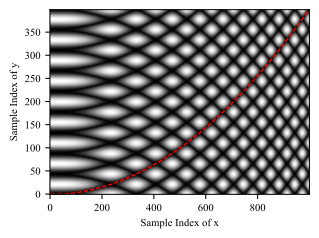
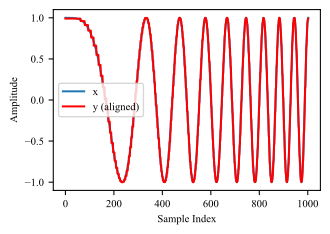
For the pair \((X,Y)\), the cost matrix \(d_{mn}=\abs {x_m-y_n}\) and the optimal warping path are shown in the left panel of Fig. 26.2. After alignment along that path the two signals match closely (Fig. 26.3, left), demonstrating how DTW stretches the time axis to find the best correspondence. Both signals contain nine cycles, and the path matches them cycle for cycle: it is almost flat at the start, where the chirp’s long opening cycle is compressed onto the cosine’s first, short one, and steepens toward the end, where the two oscillate at comparable rates.
Multivariate DTW
The multivariate case is identical to the univariate one, except that the pointwise dissimilarity is defined between vectors rather than scalars. For \(K\)-dimensional (possibly complex-valued) samples \(\mathbf {x}_m,\mathbf {y}_n\in \mathbb {C}^K\), a natural choice is the Euclidean norm of the difference,
\(\seteqnumber{0}{}{4}\)\begin{equation} d_{mn} = \norm {\mathbf {x}_m-\mathbf {y}_n}_2 = \sqrt {\sum _{k=1}^K \left (x_{k,m}-y_{k,n}\right )\left (x_{k,m}-y_{k,n}\right )^{*}}. \end{equation}
k-NN with DTW
Because DTW provides a pairwise distance between signals of possibly different lengths, it plugs directly into any distance-based classifier. The canonical choice is \(k\)-NN (Section 10): to classify a new signal, compute its DTW distance to every training signal and take a majority vote among the \(k\) nearest. With \(k=1\), 1-NN + DTW is a strong and frequently cited baseline for time-series classification.
-
Example 26.2 (1-NN on the three signals): Continuing Example 26.1, all three pairwise DTW distances are computed and normalized by \(M+L\) so that pairs of unequal length remain comparable:
\(X\) \(Y\) \(Z\) \(X\) \(0\) \(\mathbf {0.021}\) \(0.070\) \(Y\) \(0.021\) \(0\) \(0.024\) \(Z\) \(0.070\) \(0.024\) \(0\)
26.2.2 Shapelets
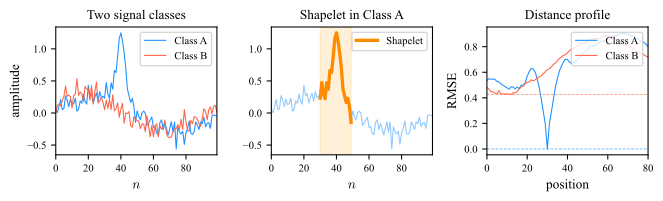
A shapelet is a sub-sequence \(S = (s_1,\ldots ,s_l)\) of length \(l\) that is “maximally representative of a class” [18].
Shapelet distance
Given a shapelet \(S\) of length \(l\) and a signal \(X = (x_1,\ldots ,x_L)\) of length \(L\), the shapelet distance is the minimum distance over all possible alignments:
\(\seteqnumber{0}{}{5}\)\begin{equation} d(S, X) = \min _{i=1,\ldots ,L-l+1} \sqrt {\frac {1}{l}\sum _{j=1}^{l}(s_j - x_{i+j-1})^2} \end{equation}
This sliding-window RMSE measures how well the shapelet matches anywhere in the signal (Fig. 26.4).
Classification
-
1. Extract shapelet candidates from the training set (sub-sequences of varying lengths).
-
2. For each candidate, compute its distance to every training signal.
-
3. Select the shapelet(s) whose distances best separate the classes (e.g. by information gain).
-
4. Use the shapelet distances as features for a classifier (e.g. decision tree, SVM).
Properties
-
• A signal may contain more than one discriminative shapelet; multiple shapelets can be combined as a feature vector.
-
• Shapelets are interpretable — they correspond to physically meaningful signal patterns.
-
• Optimized for time-domain analysis; less effective for signals whose discriminative information lies in repeated patterns or the frequency domain.
-
• Shapelet discovery can be computationally expensive (\(O(L^2 \cdot l)\) per candidate); approximate and learned methods exist to reduce cost.
In Python: tslearn (shapelet learning), sktime (shapelet transform classifier).
26.3 Pseudo-Random-Features-Based Classifiers
The methods of this section share one recipe.
-
1. Split the signal into many short windows whose positions and lengths are drawn at random.
-
2. Compute a few of inexpensive feauters each window.
-
3. Concatenate all of them into a single feature vector.
-
4. Hand feature vector by an ordinary tabular classifier.
The main drawback: no interpretability.
The two instances below differ mainly in which summaries are computed inside each window: time-domain statistics for TSF, spectral ones for RISE.
26.3.1 Time-series forest
Time-series forest (TSF) is an interval-based method. Instead of operating on raw samples or shapelets, it extracts simple statistics from randomly chosen sub-intervals of the signal.
Algorithm
-
1. For each tree in the forest, randomly select \(\sqrt {L}\) intervals \([a_i, b_i] \subset \{1,\ldots ,L\}\), where \(L\) is the number of samples in the signal, so the number of intervals grows only as its square root.
-
2. From each interval, extract three summary features: mean, standard deviation, and slope.
-
3. Train a decision tree on the resulting feature vector (of length \(3\sqrt {L}\)).
-
4. Repeat for all trees and aggregate predictions by majority vote.
Properties
-
• Computationally efficient compared to shapelet-based methods.
-
• Captures interval-level (phase) information rather than point-level or subsequence-level patterns.
26.3.2 Random Interval Spectral Ensemble (RISE)
RISE keeps the ensemble-over-random-intervals recipe and changes what is computed inside an interval: the mean, standard deviation and slope of TSF are replaced by spectral summaries.
Three families of coefficients are computed on that interval and concatenated into the tree’s feature vector:
-
• Periodogram coefficients: the first values of \(P(\omega )\) (Eq. (20.48)) evaluated on the interval, which report how its power is distributed over frequency (Sec. 21.2). A dominant oscillation shows up as one large coefficient.
-
• Auto-correlation coefficients: \(R_{\bxx }[k]\) at the first lags \(k\) (Sec. 21.1). This is the same information read in the time domain, and it is the family that carries the interval’s correlation time.
-
• Auto-regressive coefficients: the coefficients of an AR(\(p\)) model fitted to the interval (Sec. 21.3), obtained from the ACF through the Yule–Walker equations (Sec. 21.3.1). A handful of them summarizes the whole spectral shape, so they are the compact alternative to keeping many periodogram bins.
How many coefficients to keep from each family is a hyper-parameter, and the three are stacked into one vector before the tree is fitted.
In Python: sktime (interval-based classifiers including TSF and RISE).
26.4 Symbolic aggregate approximation (SAX)
Algorithm
-
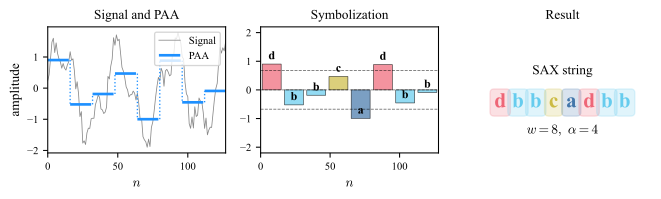
1. Piecewise Aggregate Approximation (PAA): divide the signal of length \(L\) into \(w\) equal-length segments and replace each segment by its mean, producing a reduced representation of length \(w\).
-
2. Symbolization: map each mean value to a symbol from an alphabet of size \(\alpha \) using breakpoints derived from the standard normal distribution (assuming z-normalized data). The result is a string of length \(w\) over the alphabet \(\{a, b, \ldots \}\).
-
Example 26.3: A signal of \(L=128\) samples is converted to SAX with \(w=8\) segments and alphabet size \(\alpha =4\). The PAA reduces the signal to 8 mean values (Fig. 26.5, left). Each mean is mapped to a symbol based on the breakpoints of the standard normal distribution (center). The resulting SAX string is shown on the right.
SAX-VSM
SAX combined with the Vector Space Model (SAX-VSM) [16] applies text-classification ideas to time-series classification:
-
1. Convert each training signal to a SAX string using a sliding window, producing a “bag of words.”
-
2. Build a tf-idf weighted term-frequency vector for each class.
-
3. Classify a new signal by computing the cosine similarity of its bag-of-words vector to each class vector.
The weighting in step 2 is the standard text-retrieval one. The term frequency \(\mathrm {tf}(w,c)\) counts how many times the word \(w\) occurs in the bag of class \(c\), and the inverse document frequency
\(\seteqnumber{0}{}{6}\)\begin{equation} \label {eq-sax-vsm-tfidf} \mathrm {idf}(w) = \log \frac {C}{\abs {\{c:\,w\in c\}}} \end{equation}
discounts words by the number of classes they appear in. The entry of the class vector for word \(w\) is the product \(\mathrm {tf}(w,c)\cdot \mathrm {idf}(w)\), so a word that occurs in all \(C\) classes receives weight \(\log 1=0\) and drops out, while a word confined to a single class receives the largest weight \(\log C\). The vector therefore keeps only the symbolic patterns that separate the classes, and discards those every class shares.
Properties
-
• Interpretable: discriminative patterns correspond to readable symbolic words.
-
• Dimensionality reduction is controlled by two parameters: number of segments \(w\) and alphabet size \(\alpha \).
-
• Sensitive to the choice of \(w\) and \(\alpha \); typically selected by cross-validation.
In Python: tslearn (PAA, SAX), sktime (SAX-based classifiers).
26.5 Random Convolutions
The methods of this section share one recipe, the random-feature idea of Sec. 26.3 moved from windows to filters.
-
1. Generate a large bank of short filters whose coefficients are not learned.
-
2. Convolve each filter with the signal.
-
3. Reduce each filter output to one or two inexpensive scalar features.
-
4. Hand the concatenated scalars to a linear classifier.
The classifier is linear on purpose: the nonlinearity already sits in the convolution-and-summary stage, so the fit stays a closed-form least-squares problem even at \(10^4\) features. Learning the filters instead of drawing them is what a 1D convolutional network does, at a far higher cost in data and computation.
The main drawback: no interpretability.
The two instances below differ mainly in how the bank is built: random continuous weights for ROCKET, a fixed set of kernels for MINIROCKET.
26.5.1 ROCKET
RandOm Convolutional KErnel Transform (ROCKET) [5].
Algorithm
-
1. Generate a large number (e.g. \(10{,}000\)) of random convolutional kernels with random length, weights, bias, dilation, and padding.
-
2. Convolve each kernel with the input signal.
-
3. From each convolution output, extract two features: the maximum value and the proportion of positive values (ppv).
-
4. Train a linear classifier (e.g. ridge regression) on the resulting feature vector.
The key insight is that a sufficiently large collection of random kernels captures diverse patterns (trends, spikes, oscillations at various scales) without any learning or search over the kernel space.
Properties
-
• May be slow: training scales linearly with the number of signals and kernels.
-
• Accuracy comparable to deep learning and ensemble methods (e.g. HIVE-COTE).
-
• Not interpretable: random kernels have no direct physical meaning.
26.5.2 MINIROCKET
MINIROCKET [6] is a faster, near-deterministic variant. The main differences are summarized below.
| ROCKET | MINIROCKET | |
| Kernel weights | Random (continuous) | Fixed \(\{-1,\,2\}\) |
| Features | Max value + ppv | ppv only |
| Determinism | Stochastic | Near-deterministic |
| Speed | Fast | Up to \(75\times \) faster |
In Python: sktime (RocketClassifier, MiniRocketClassifier).
26.6 Ensemble Classifiers
26.6.1 HIVE-COTE
The Hierarchical Vote Collective of Transformation-based Ensembles (HIVE-COTE) [14] is a meta-ensemble that fuses the outputs of several diverse classifiers, each operating on a different signal domain:
-
• Time domain (e.g. shapelet transform, TSF).
-
• Frequency domain (e.g. RISE).
-
• Dictionary-based representation (e.g. SAX-based methods).
-
• Interval-based and whole-series distance-based classifiers.
Each component classifier produces a probability distribution over the classes. HIVE-COTE combines them using a weighted vote, where the weights reflect each component’s estimated accuracy.
Properties
-
• Among the most accurate non-DL classifiers on standard benchmarks.
-
• Computationally expensive: trains multiple full classifiers.
-
• Modular: individual components can be replaced or upgraded independently.
26.7 Summary
Method comparison
The methods presented in this chapter are compared below. The “domain” column indicates the signal representation used by each method. Accuracy and speed are qualitative rankings on standard benchmarks.
| Method | Domain | Accuracy | Speed | Interpretable |
| DTW + \(k\)-NN | Time (distance) | Moderate | Slow | No |
| Shapelets | Time (sub-sequence) | Moderate | Slow | Yes |
| TSF / RISE | Time / Frequency (interval) | Moderate | Fast | Partially |
| SAX-VSM | Symbolic | Moderate | Fast | Yes |
| ROCKET | Time (random convolution) | High | Fast | No |
| HIVE-COTE | Multi-domain (ensemble) | Highest | Very slow | No |
Classical vs. DL approaches
| Classical (non-DL) | DL | |
| Signal modeling | Not required | Not required |
| Multivariate signals | Less effective | Naturally supported |
| Interpretability | Limited (except shapelets, SAX) | Limited |
| Generalization | Low | High |
| Complexity | High vs. model-based | High |
| Feature engineering | Required (hand-crafted) | Learned automatically |
| Data requirements | Moderate | Large (orders of magnitude more) |
| Hyper-parameters | Few | Many; optimization required |
| Non-linear signals | Supported | Supported |