Machine Learning & Signals Learning
1 Descriptive Statistics Basics
1.1 Sample and Population Variance
Preliminaries
We assume a uni-variate random experiment that is described by a real-valued random variable \(X\) with
\(\seteqnumber{0}{}{0}\)\begin{align*} \E [X] &=\mu \\ \Var [X] &= \sigma ^2. \end{align*}
Let
\(\seteqnumber{0}{}{0}\)\begin{equation} \bx =\{x_1,\dots ,x_n\} \end{equation}
be \(n\) observations of \(X\), where \(n\) may be fixed in advance or chosen arbitrarily.
1.1.1 Definition
Sample mean Given observations \(x_1,\dots ,x_n\), the sample mean \(\bar {\bx }\) is given by
\(\seteqnumber{0}{}{1}\)\begin{equation} \bar \bx = \frac 1n\sum _{i=1}^n x_i \end{equation}
Sample variance Sample variance is given by
\(\seteqnumber{0}{}{2}\)\begin{align} s_{\text {unbiased}}^2 =\frac 1{n-1}\sum _{i=1}^n\bigl (x_i-\bar {x}\bigr )^2 \end{align} This formulas is unbiased.
Population variance The more intuitive (biased) population variance formula is
\(\seteqnumber{0}{}{3}\)\begin{equation} s_{\text {biased}}^2 =\frac 1n\sum _{i=1}^n\bigl (x_i-\bar {x}\bigr )^2\\ \end{equation}
Standard Deviation The sample standard deviation (std) is simply the square-root of the (unbiased or biased) sample variance, \(s\).
| Aspect | Variance (\(s^2\)) | Std. Dev. (\(s\)) |
| Units | (original unit)\(^2\) | original unit |
| Interpretation | “Mean squared deviation” | “Average deviation from the mean” |
| Ease of communication | Abstract (squared units) | Concrete (\(\pm 5\) kg) |
1.1.2 Repeated Experiments Characterization
The repeated experiments approach is based on
-
• \(k\) experiments
-
– In each experiment \(n\) samples \(\bx _1,\ldots ,\bx _k\) are drawn from the known random variable \(X\).
-
Mean
The average of repeated experiments values is itself approximately \(\mu \), so on average the sample mean
\(\seteqnumber{0}{}{4}\)\begin{equation} \bar {\mu }_k = \frac {1}{k}\sum _{j=1}^{k}\bar {\bx }_j \end{equation}
recovers the true mean
\(\seteqnumber{0}{}{5}\)\begin{equation} \lim _{k\rightarrow \infty }\bar {\mu }_k \rightarrow \mu \end{equation}
This principle is illustrated in Fig. 1.1.

Fluctuations of \(\bar {\mu }_k\):
-
• As you gather more observations (higher \(n\)), \(\bar \bx \) tends to stabilize: it fluctuates less, and its empirical distribution concentrates around the true center \(\mu \).
-
• Moreover, for large \(n\), the variability of \(\bar \bx \) scales like \(\sigma /\sqrt {n}\) (or \(\Var [\bar x]\approx \dfrac {\sigma ^2}{n}\)), meaning the more data we collect, the tighter our estimate of the process’s center becomes.
Variance
In the case of biased variance, the mean of the \(s_{n_1},\ldots ,s_{n_k}\) values
\(\seteqnumber{0}{}{6}\)\begin{equation} \bar {s}_k^2 = \frac {1}{k}\sum _{j=1}^{k}s_{n_j} \end{equation}
systematically underestimates the true population variance \(\sigma ^2\),
\(\seteqnumber{0}{}{7}\)\begin{equation} \lim _{k\rightarrow \infty }\bar {s}_{k,\text {biased}}^2 \rightarrow \dfrac {n-1}{n}\sigma ^2 \end{equation}
This inherent difference is termed bias. However, for the unbiased variance,
\(\seteqnumber{0}{}{8}\)\begin{equation} \lim _{k\rightarrow \infty }\bar {s}_{k,\text {unbiased}}^2 \rightarrow \sigma ^2 \end{equation}
This principle is illustrated in Fig. 1.2.
Note, the difference between \(s_\text {biased}\) and \(s_{\text {unbiased}}\) goes smaller for high \(n\).

Standard Error
The fluctuation of \(\bar x\) noted above has a name and a closed form. The standard error is the standard deviation of an estimate, as opposed to the standard deviation of the data the estimate was computed from.
For the sample mean of \(n\) uncorrelated samples of variance \(\sigma ^2\), the variances of the \(n\) terms add, while the \(1/n\) in front of the sum is squared,
\(\seteqnumber{0}{}{9}\)\begin{equation} \label {eq-se-variance} \Var [\bar x] = \frac {1}{n^2}\sum _{i=1}^{n}\Var [x_i] = \frac {n\sigma ^2}{n^2} = \frac {\sigma ^2}{n} , \end{equation}
so that
\(\seteqnumber{0}{}{10}\)\begin{equation} \label {eq-standard-error} \mathrm {SE}(\bar x) = \sqrt {\Var [\bar x]} = \frac {\sigma }{\sqrt {n}} . \end{equation}
The square root appears because it is the variances that add, not the amplitudes.
Eq. (1.11) is read as a budget: the precision of the mean improves only with the square root of the sample size, so halving the standard error costs four times the data. The population \(\sigma \) is rarely known, and in practice it is replaced by the sample standard deviation \(s_x\),
\(\seteqnumber{0}{}{11}\)\begin{equation} \label {eq-standard-error-estimated} \widehat {\mathrm {SE}}(\bar x) = \frac {s_x}{\sqrt {n}} . \end{equation}
\(\sigma \) or \(\mathrm {SE}\)
The two answer different questions. \(\sigma \) is the spread of the data, and it does not change as more data is collected. The standard error is the spread of the estimate, and it shrinks as \(1/\sqrt {n}\). Reporting \(\sigma \) where \(\mathrm {SE}(\bar x)\) is meant overstates the uncertainty of the mean, and the reverse hides the variability of the population.
Uncorrelated samples
MSE
The reason that biased estimator is still useful, is the when the empirical mean-squared error (MSE) is of interest. MSE is defined by
\(\seteqnumber{0}{}{12}\)\begin{align} \mathrm {\overline {MSE}}_{\text {unbiased}} &= \frac {1}{k}\sum _{j=1}^k \left (s_{{\text {unbiased}}_j} - \sigma ^2\right )^2 \rightarrow \frac {2}{n-1}\,\sigma ^4\\ \mathrm {\overline {MSE}}_{\text {biased}} &= \frac {1}{k}\sum _{j=1}^k \left (s_{{\text {biased}}_j} - \sigma ^2\right )^2 \rightarrow \frac {2n-1}{n^2}\,\sigma ^4 \end{align} and
\(\seteqnumber{0}{}{14}\)\begin{equation} \mathrm {\overline {MSE}}_{n-1} \geq \mathrm {\overline {MSE}}_{n} \end{equation}
Note, that MSE error of the biased formula is slightly lower than unbiased one.
-
Example 1.1 (Unbiasedness and variance of the sample mean, and biased vs. unbiased variance estimators): Sample mean is unbiased and its variance decays as \(\sigma ^2/n\). The usual sample-variance estimators can be biased or unbiased. We illustrate all three properties by simulation:
-
1. Parameters.
-
• True distribution: \(X\sim \mathcal {N}(0,1)\), so \(\mu =0\), \(\sigma ^2=1\).
-
• Sample sizes: \(n\in \{5,\,20,\,100\}\).
-
• Number of replicates: \(k=5000\).
-
-
2. Results. Results in Table 1.2 agree closely with the theoretical values. Read as standard errors, Eq. (1.11), the three empirical variances of \(\bar x\) are \(0.445\), \(0.221\) and \(0.100\), against \(\sigma /\sqrt {n} = 0.447\), \(0.224\) and \(0.100\). Quadrupling \(n\) from \(5\) to \(20\) halves the standard error, exactly as Eq. (1.11) requires.
Table 1.2: Simulation results: sample mean, variance estimates, and their MSEs across different sample sizes.\(n\) \(\bar \mu _n\) Empirical \(\Var [\bar x]\) Theoretical \(\Var [\bar x]=1/n\) \(\bar s^2_{\mathrm {biased}}\) \(\bar s^2_{\mathrm {unbiased}}\) \(\overline {MSE}_{\mathrm {biased}}\) \(\overline {MSE}_{\mathrm {unbiased}}\) 5 \(0.001\) \(0.198\) \(0.200\) \(0.79\) \(0.99\) \(0.36\) \(0.50\) 20 \(-0.000\) \(0.049\) \(0.050\) \(0.95\) \(1.00\) \(0.10\) \(0.11\) 100 \(0.000\) \(0.010\) \(0.010\) \(0.99\) \(1.01\) \(0.02\) \(0.02\) -
1.1.3 Bias
The bias of a sample statistic is the systematic difference between its long-run average over repeated experiments and the corresponding true value of the random variable. A statistic is called unbiased when this difference is zero, and biased otherwise.
For example, for the sample variance,
\(\seteqnumber{0}{}{15}\)\begin{equation} \mathrm {bias}(s^2) = \lim _{k\to \infty }\bar {s}_k^2 - \sigma ^2. \end{equation}
Therefore, \(s_{\text {unbiased}}^2\) is unbiased while \(s_{\text {biased}}^2\) has bias \(-\sigma ^2/n\).
The application of biased and unbiased estimators:
-
• Biased: in ML tasks (e.g., loss function), optimal (maximum-likelihood estimation) for Gaussian distribution
-
• Unbiased: statistics.
Code implementation default varies:
1.2 Mode, Skewness and Median
1.2.1 Median
Median is a value or quantity lying at the midpoint of a frequency distribution of observed values or quantities, such that there is an equal probability of falling above or below it.
Equivalently, for a sample \(x_1,\dots ,x_n\) with order statistics \(x_{(1)}\le \cdots \le x_{(n)}\), the sample median is
\[ \mathrm {median}( x) = \begin {cases} x_{(\frac {n+1}2)}, & n\text { odd},\\[6pt] \dfrac {x_{(\frac n2)} + x_{(\frac n2 + 1)}}2, & n\text { even}. \end {cases} \]
1.2.2 Mode
For a finite sample \(x_1,\dots ,x_n\), the sample mode is any value(s) that occur(s) most often among the observations.
Multimodality: A distribution is called multimodal if it has more than one local maximum (mode) in its probability density function or histogram. Common cases include:
-
• Unimodal: a single peak (e.g., normal distribution).
-
• Bimodal: two distinct peaks, often indicating that the data is a mixture of two subpopulations.
-
• Multimodal: three or more peaks.
Multimodality suggests that the data may come from a mixture of different underlying processes or groups.
1.2.3 Skewness
Skewness: Skewness measures the asymmetry of a distribution about its mean. The sample skewness is defined as
\[ g_1 = \frac {1}{n}\sum _{i=1}^{n}\!\left (\frac {x_i - \bar {x}}{s_n}\right )^{\!3}. \]
-
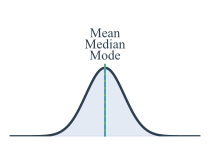
• \(g_1 = 0\): the distribution is symmetric (e.g., normal distribution).
-
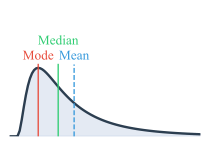
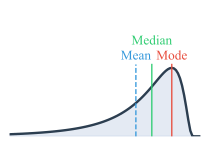
• \(g_1 > 0\): the distribution is right-skewed (positively skewed) — the right tail is longer, and the mean is typically greater than the median.
-
• \(g_1 < 0\): the distribution is left-skewed (negatively skewed) — the left tail is longer, and the mean is typically less than the median.
An illustration of the relationship between mean, median, and mode under different skewness is shown in Fig. 1.3.
1.3 Boxplot
1.3.1 Prelinaries
Quartiles: Given the order statistics \(x_{(1)}\le \cdots \le x_{(n)}\), the three quartiles divide the sorted data into four equal parts:
-
• \(Q_1\) (first quartile, 25th percentile) — the median of the lower half of the data.
-
• \(Q_2\) (second quartile, 50th percentile) — the median of the entire data set.
-
• \(Q_3\) (third quartile, 75th percentile) — the median of the upper half of the data.
Equivalently, approximately 25% of the observations fall below \(Q_1\), and another 25% up to \(Q_3\).
Interquartile range: The interquartile range (IQR) measures the spread of the central 50% of the data,
\(\seteqnumber{0}{}{16}\)\begin{equation} \mathrm {IQR} = Q_3 - Q_1. \end{equation}
Outlier: An outlier is any observation that falls outside the interval
\[ \bigl [Q_1 - 1.5\,\mathrm {IQR},\;\; Q_3 + 1.5\,\mathrm {IQR}\bigr ]. \]
Such points are considered unusually far from the bulk of the data and may indicate measurement errors, rare events, or heavy-tailed behavior.
The coefficient 1.5 was proposed empirically by statistician John Tukey in 70th.
1.3.2 Plot
A boxplot (box-and-whisker plot) summarizes a data set using five statistics:
-
1. Minimum non-outlier value.
-
2. First quartile (\(Q_1\)).
-
3. Median (\(Q_2\)).
-
4. Third quartile (\(Q_3\)).
-
5. Maximum non-outlier value.
The boxplot is drawn as follows:
-
• A box spans from \(Q_1\) to \(Q_3\), with a line at the median \(Q_2\).
-
• Whiskers extend from the box to the most extreme data points that lie within
\[ \bigl [Q_1 - 1.5\,\mathrm {IQR},\;\; Q_3 + 1.5\,\mathrm {IQR}\bigr ]. \]
-
• Any observation outside the whisker range is marked individually as a potential outlier.
An illustration of a boxplot with its components is shown in Fig. 1.4.

Interpretation
-
• The box width (IQR) reflects variability — a wide box indicates high spread.
-
• The median line position within the box reveals skewness: if the median is closer to \(Q_1\), the distribution is right-skewed; if closer to \(Q_3\), left-skewed.
-
• Whisker lengths indicate the range of typical observations.
-
• Individual points beyond the whiskers flag potential outliers that may warrant further investigation.
Unlike histograms, boxplots do not show the shape of the distribution (e.g., multimodality). They are most useful for comparing distributions across groups side by side.
1.4 Histogram
1.4.1 Discrete Values
count type
Consider an experiment with:
-
• \(k\) possible distinct outcomes \(x_{1},x_{2},\ldots ,x_{k}\), where \(k\) is relatively small.
-
• A total of \(N\) trials.
-
• Recorded results:
-
– \(n_{1}\) occurrences of \(x_{1}\),
-
– \(n_{2}\) occurrences of \(x_{2}\),
-
– \(\ldots \) and so on,
with \(\sum _{i} n_{i}=N\).
-
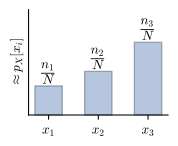
The highest bar in a count histogram identifies the mode of the sample. A graphical representation of the outcomes is shown in Fig. 1.5(a).

probability type
Approximation to the PDF: The probability of a particular outcome is approximated by the ratio of its count to the total number of trials,
\(\seteqnumber{0}{}{17}\)\begin{equation} \label {eq:rand1:numeric_PDF_discr} p_X[x_i]\approx \frac {n_i}{N}, \qquad i = 1,\ldots ,k. \end{equation}
Naturally, the approximation improves as \(N \to \infty \).
A graphical example of this histogram type is shown in Fig. 1.5(b).
1.4.2 Continuous Values
When the number of possible outcomes, \(k\), is large (on the order of hundreds or more, or continuous values) two main difficulties arise:
-
• Presenting the results in a compact, readable form.
-
• Some outcome categories contain very few observations because their probabilities are small.
A practical way to display the data is:
-
1. Record the extreme values, \(x_{\max }\) and \(x_{\min }\).
-
2. Partition the interval \(\bigl [x_{\min },x_{\max }\bigr ]\) into \(k\) equal-width bins of size \(\Delta x\).
-
3. Mark each bin by its midpoint
\(\seteqnumber{0}{}{18}\)\begin{equation} \label {eq:rand1:mid_point} \tilde {x}_{i}=x_{\min }+\Bigl (i-\frac 12\Bigr )\,\Delta x, \qquad i=1,\dots ,k, \end{equation}
-
4. Let \(n_{1}\) be the count in the first bin, \(n_{2}\) the count in the second, and so on.
-
5. Use the pairs the pairs \(\left (\tilde {x}_{i},n_{i}\right )\) for count or probability type histograms.
An example of a count histogram for a large data set is shown in Fig. 1.6.
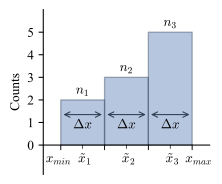
In this representation, the median is the value on the x-axis that divides the total area of the histogram into two equal parts. The variance \(s^2\) and standard deviation \(s\) are reflected in the width or spread of the histogram: a broad histogram indicates high variability, while a narrow, sharp peak indicates that the data is tightly clustered around the mean.
add illustration/example
1.4.3 PDF Approximation of Continuous Random Variable (*)
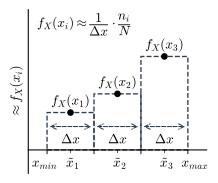
In addition to the binning method described above, there is a third histogram type that directly approximates the PDF of a continuous random variable.
Approximation to the PDF of a continuous random variable via histogram:
\(\seteqnumber{0}{}{19}\)\begin{equation} \label {eq:stat:hist_pdf} f_X(x_i) \approx \frac {n_i}{N}\cdot \frac {1}{\Delta x}, \quad i = 1,\ldots ,k \end{equation}
Note the normalization factor \(1/\Delta x\), which distinguishes this from the discrete case in (1.18).
A graphical example of this histogram type is shown in Fig. 1.7.
Derivation
Based on the principle
\(\seteqnumber{0}{}{20}\)\begin{equation} \Pr (a<X\le b) = \int _{a}^{b}f_X(x)\,dx, \end{equation}
the probability of falling within a bin of width \(\Delta x\) centered at \(x_0\) can be approximated as
\(\seteqnumber{0}{}{21}\)\begin{align} \Pr \!\Bigl (x_0-\tfrac {\Delta x}{2} < X \le x_0 +\tfrac {\Delta x}{2}\Bigr ) &= \int _{\Delta x}f_X(x)\,dx \approx f_X(x_0)\,\Delta x. \end{align} An illustration of this principle is shown in Fig. 1.8.

Rearranging,
\(\seteqnumber{0}{}{22}\)\begin{equation} \label {eq:stat:histogram_deriv} f_X(x_0) \approx \Pr \!\Bigl (x_0-\tfrac {\Delta x}{2} < X \le x_0 +\tfrac {\Delta x}{2}\Bigr )\cdot \frac {1}{\Delta x}. \end{equation}
The probability of falling in bin \(i\) (centered at \(\tilde {x}_i\)) is approximated by the relative frequency,
\(\seteqnumber{0}{}{23}\)\begin{equation} \label {eq:stat:hist_prob} \Pr \!\Bigl (\tilde {x}_i-\tfrac {\Delta x}{2} < X \le \tilde {x}_i +\tfrac {\Delta x}{2}\Bigr ) \approx \frac {n_i}{N}, \quad i = 1,\ldots ,k. \end{equation}
Substituting (1.24) into (1.23) yields the PDF approximation formula in (1.20).
-
Example 1.2 (Computing a PDF histogram): Given the experimental outcomes
\[ \left [16,\,98,\,96,\,49,\,81,\,14,\,43,\,92,\,80,\,96\right ], \]
display the PDF using a histogram with \(k=3\) bins.
-
\(\seteqnumber{0}{}{24}\)
\begin{align*} N &= 10\\ x_{\min } &= 14,\quad x_{\max } = 98\\ x_{\max } &= x_{\min } + k\,\Delta x = 98\quad \Rightarrow \Delta x = \frac {x_{\max }-x_{\min }}{k} = \frac {84}{3} = 28 \end{align*} Counts per bin:
\(\seteqnumber{0}{}{24}\)\begin{align*} n_1 &= 2, &\leftarrow \lbrace 14,16\rbrace &\in [x_{\min },\;x_{\min } + \Delta x] &&= [14,42]\\ n_2 &= 2, &\leftarrow \lbrace 43, 49\rbrace &\in (x_{\min } + \Delta x,\;x_{\min } + 2\Delta x] &&= (42,70]\\ n_3 &= 6, &\leftarrow \lbrace 80,81,92,96,96,98\rbrace &\in (x_{\max } - \Delta x,\;x_{\max }] &&= (70,98] \end{align*} where \(n_3 = 10 - n_1 - n_2\). Bin midpoints:
\(\seteqnumber{0}{}{24}\)\begin{align*} \tilde {x}_1 &= x_{\min } + \tfrac {\Delta x}{2} = 28\\ \tilde {x}_2 &= x_{\min } + \Delta x + \tfrac {\Delta x}{2} = 56\\ \tilde {x}_3 &= x_{\max } - \tfrac {\Delta x}{2} = 84 \end{align*} The PDF approximation is therefore
\[ f_X(\tilde {x}_i) \approx \frac {n_i}{N\cdot \Delta x} = n_i \cdot \frac {1}{10\cdot 28}. \]
-
\(\seteqnumber{0}{}{24}\)
Summary
Three ways to display experimental results as a histogram:
-
• count: plot \(n_i\) — the raw bin counts.
-
• probability: plot \(n_i/N\) — the relative frequency per bin.
-
• pdf (or density): plot \(\dfrac {n_i}{N\,\Delta x}\) — the estimated probability density.
1.5 Violin Plot
A violin plot extends the boxplot by adding a (smoothed1) histogram of the data on each side. A median line is typically drawn inside.
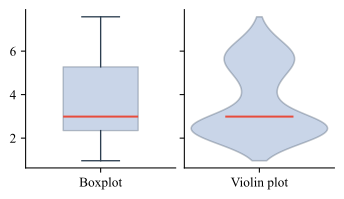
Fig. 1.9 compares the two representations for the same bimodal data set: the boxplot gives no indication of two groups, whereas the violin plot clearly shows two bulges.
1 This smoothing is termed kernel density estimation (KDE). It is a special case of kernel smoothing in Sec. 5.5. The discussion of this technique is beyond the scope of this chapter.
1.6 Monte-Carlo Simulation
The repeated experiments of Sec. 1.1 are an instance of a general numerical method, known as Monte-Carlo simulation. Instead of deriving the behavior of a statistic analytically, the random experiment is reproduced \(k\) times on a computer, and the resulting \(k\) values are summarized by the very same descriptive tools of this chapter.
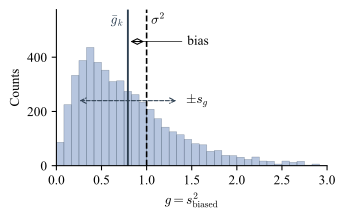
Formally, let \(g\) be any statistic computed from a sample of \(n\) observations, e.g. \(\bar {\bx }\), \(s^2_{\text {biased}}\) or the MSE. Its expected value is approximated by the average over \(k\) independent repetitions,
\(\seteqnumber{0}{}{24}\)\begin{equation} \label {eq-monte-carlo} \E [g]\approx \bar {g}_k = \frac 1k\sum _{j=1}^{k}g_j, \end{equation}
where the law of large numbers guarantees \(\bar {g}_k \rightarrow \E [g]\) as \(k\rightarrow \infty \). The spread of \(g\) is estimated from the very same \(k\) values,
\(\seteqnumber{0}{}{25}\)\begin{equation} \label {eq-mc-var} \Var [g]\approx s_g^2 = \frac 1k\sum _{j=1}^{k}\left (g_j-\bar {g}_k\right )^2,\qquad s_g=\sqrt {s_g^2}, \end{equation}
and \(\bar {g}_k-\theta \) estimates the bias with respect to a known true value \(\theta \) (Sec. 1.1.3).
The value of \(s_g\) is set by the sample size \(n\) and by the distribution of \(X\): it reports how much the statistic varies from one experiment to the next, and no number of repetitions reduces it. Making the statistic itself less variable requires a larger \(n\). The number of repetitions \(k\) controls something different, namely how accurately \(\bar {g}_k\) and \(s_g\) estimate the quantities they stand for.
The strength of the method is that (1.25) requires no derivation: it holds for any statistic, any distribution of \(X\), and any sample size \(n\), including all the cases where an analytical expression is unavailable or valid only for large \(n\).
Monte-Carlo recipe
-
1. Fix the data-generating model and the true parameter values, e.g. \(X\sim \mathcal {N}(\mu ,\sigma ^2)\) with the selected \(\mu \) and \(\sigma ^2\).
-
2. Draw one realization of \(n\) observations \(x_1,\ldots ,x_n\).
-
3. Compute the statistic of interest \(g_j\) from this realization.
-
4. Repeat items 2–3 for \(j=1,\ldots ,k\), storing all the \(k\) values.
-
5. Summarize the stored values: their mean (1.25) estimates \(\E [g]\) and the bias (Sec. 1.1.3), their std \(s_g\) (1.26) estimates the spread of \(g\), and their histogram (Sec. 1.4), boxplot (Sec. 1.3) or violin plot (Sec. 1.5) reveals the whole distribution of \(g\).
The whole recipe is summarized in Fig. 1.10: the model feeds \(k\) independent experiments of \(n\) observations each, every experiment is reduced to a single value \(g_j\), and only the collection of the \(k\) values is interpreted.

Table 1.2 is precisely the output of this recipe, applied to the sample mean, the two variance estimators and their MSEs, with \(n\in \{5,20,100\}\) and \(k=5000\). Each of its entries condenses \(k\) stored values into a single number; Fig. 1.11 shows the values themselves behind one entry.
1.6.1 Number of Experiments
The simulated result is itself a random quantity, so it carries an error of its own, and this error is controlled by \(k\) alone.
Simulated mean The std of a simulated mean is
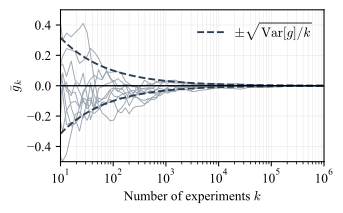
\(\seteqnumber{0}{}{26}\)\begin{equation} \label {eq-mc-error-mean} \sqrt {\Var [\bar {g}_k]} = \frac {\sqrt {\Var [g]}}{\sqrt {k}}, \end{equation}
where \(\Var [g]\) is the spread (1.26) of the individual \(g_j\): the accuracy of a simulated mean is the spread of the statistic divided by \(\sqrt {k}\).
Simulated std and variance Similarly, the relative error of a simulated std \(s_g\) is
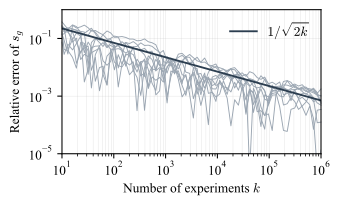
\(\seteqnumber{0}{}{27}\)\begin{equation} \label {eq-mc-error-std} \frac {\sqrt {\Var [s_g]}}{s_g}\approx \frac {1}{\sqrt {2k}}, \end{equation}
while the relative error of a simulated variance \(s_g^2\) is twice as large,
\(\seteqnumber{0}{}{28}\)\begin{equation} \label {eq-mc-error-var} \frac {\sqrt {\Var [s_g^2]}}{s_g^2}\approx \sqrt {\frac {2}{k}} = \frac {2}{\sqrt {2k}}. \end{equation}
The factor of two follows from squaring: a variance is the square of a std, and squaring doubles the relative fluctuation. A simulated variance is therefore always twice as uncertain as the simulated std obtained from the very same \(k\) values, and the two should not be quoted with the same accuracy.
All three decay as \(1/\sqrt {k}\), so halving the simulation error costs four times more experiments. Representative values are listed in Table 1.3 and illustrated in Fig. 1.12 for the simulated mean and in Fig. 1.13 for the simulated std.
| \(k\) | Mean, \(1/\sqrt {k}\) | Std, \(1/\sqrt {2k}\) | Variance, \(\sqrt {2/k}\) |
| \(10^2\) | \(10\%\) | \(7.1\%\) | \(14\%\) |
| \(10^3\) | \(3.2\%\) | \(2.2\%\) | \(4.5\%\) |
| \(10^4\) | \(1.0\%\) | \(0.7\%\) | \(1.4\%\) |
| \(10^5\) | \(0.32\%\) | \(0.22\%\) | \(0.45\%\) |
| \(10^6\) | \(0.10\%\) | \(0.07\%\) | \(0.14\%\) |
The consequence is that a simulated value is never exact, and the number of correct digits it carries is set by \(k\). In Table 1.2, for instance, \(k=5000\) yields a variance error of about \(2\%\) (1.29), which is why the \(n=100\) row reads \(\bar s^2_{\mathrm {unbiased}}=1.01\) rather than the exact \(1.00\).
Derivation (*) Where do the three formulas come from? Each one answers the same question: if the whole simulation is repeated with a new seed, how far does the reported number move?
Start with the mean. The stored values \(g_1,\ldots ,g_k\) are independent, so their variances add up, and dividing their sum by \(k\) divides the variance by \(k^2\),
\(\seteqnumber{0}{}{29}\)\begin{equation*} \Var [\bar {g}_k] = \frac {1}{k^2}\sum _{j=1}^{k}\Var [g_j] = \frac {\Var [g]}{k}. \end{equation*}
The square root of this is (1.27). It is the familiar \(\sigma ^2/n\) rule of the sample mean (Sec. 1.1), applied to \(k\) experiments instead of \(n\) observations. Only independence was used, so this rate is valid for any distribution of \(g\). This is also the one rate given as an absolute value instead of a percentage: a percentage would divide by \(\E [g]\), which is zero whenever the simulation checks a bias against zero.
The variance needs one known result. For Gaussian values, the sum of the squared deviations follows a chi-square distribution, whose variance is twice its number of degrees of freedom. With \(k\) values this gives
\(\seteqnumber{0}{}{29}\)\begin{equation*} \Var [s_g^2] \approx \frac {2\sigma _g^4}{k}, \end{equation*}
and dividing by \(s_g^2\approx \sigma _g^2\) turns it into the percentage (1.29).
The std needs no new assumption, only a square root. A small relative change of the variance shrinks to half of itself after the square root is taken,
\(\seteqnumber{0}{}{29}\)\begin{equation*} s_g = \sigma _g\sqrt {1+\varepsilon }\approx \sigma _g\left (1+\frac {\varepsilon }{2}\right ), \end{equation*}
so a variance known to \(\pm 10\%\) gives a std known to \(\pm 5\%\). Halving \(\sqrt {2/k}\) gives \(1/\sqrt {2k}\), which is (1.28).
Note that only the middle step assumed a Gaussian. When \(g\) has heavier tails, rare large values inflate the squared deviations, and both the variance and the std are then less accurate than these formulas promise. The mean is unaffected. Whether the variance is normalized by \(k\) or by \(k-1\) makes no visible difference at these accuracies.
1.6.2 Reproducibility
A computer draws pseudo-random numbers, produced by a deterministic algorithm from an initial value called the seed. Fixing the seed makes the whole simulation exactly repeatable, which is a requirement for a reported result, not an option.
-
• Python: numpy.random.default_rng(seed).
-
• Matlab: rng(seed).
-
• A single realization proves nothing. Any conclusion has to be drawn from the \(k\) collected values.
-
• Report \(k\) and store the seed next to every simulated number, so that its accuracy (1.28) can be judged.
-
• Never try select the seed that produces “better” result, i.e. “lucky shot”. The seed is fixed before the experiment, not after it.